I am not in the habit of making new year resolutions and goals for a “new” me in the new year and I will not start this year. At least, not exactly. Instead, I want to try to understand more of the “old” me.
I used this holiday break to write less and read more. During this time, 3 writings I happened to stumble upon seemed to come serendipitously together: this and this articles on Acceptance and Commitment Therapy (ACT), a free 30 days email course on building habits by James Clear and some ideas on focusing my awareness from the book Aware by Daniel J. Siegel.
What follows is a description of an exercise I intend to run in the following period with myself in an attempt to invest my personal development time in a more focused way. So I am not looking into a complete transformation of how I behave (since I don’t think that is sustainable), but more to bring more focus in each area of my life. Also, this is a high-level overview of an unfinished exercise that I will probably continue polishing over the next few months. Nevertheless, I hope the ideas I mention and reference here are still useful to someone else.
Values
First, I want to identify my personal values.
“In ACT, we think of values as what we ultimately want our lives to be about. They’re about how we want to live our moments, knowing that we’ll die someday.” (Casey Rosengren, How to Live by Your Values This Year)
This is an exercise I tried to do several times in the past, but without really finalizing it. Biggest problem was that I found it quite hard to narrow down the list. This time, I will try something different. I made a cheap copy of the amazing Live Your Values card deck that is smaller to fit my board and I filtered the values to include all that resonate most with me at this point. This was a very generous selection, instead of struggling to reduce the number of the values, I did exactly the opposite (which was way more satisfying).
“It’s also important to note that values aren’t something you reason your way to. They aren’t moralistic, and they don’t require any rational justification. Values are about what gives you an experiential sense of meaning and purpose, not a philosophical position on what you think should matter in life or what someone else thinks is important.” (Casey Rosengren, How to Live by Your Values This Year)
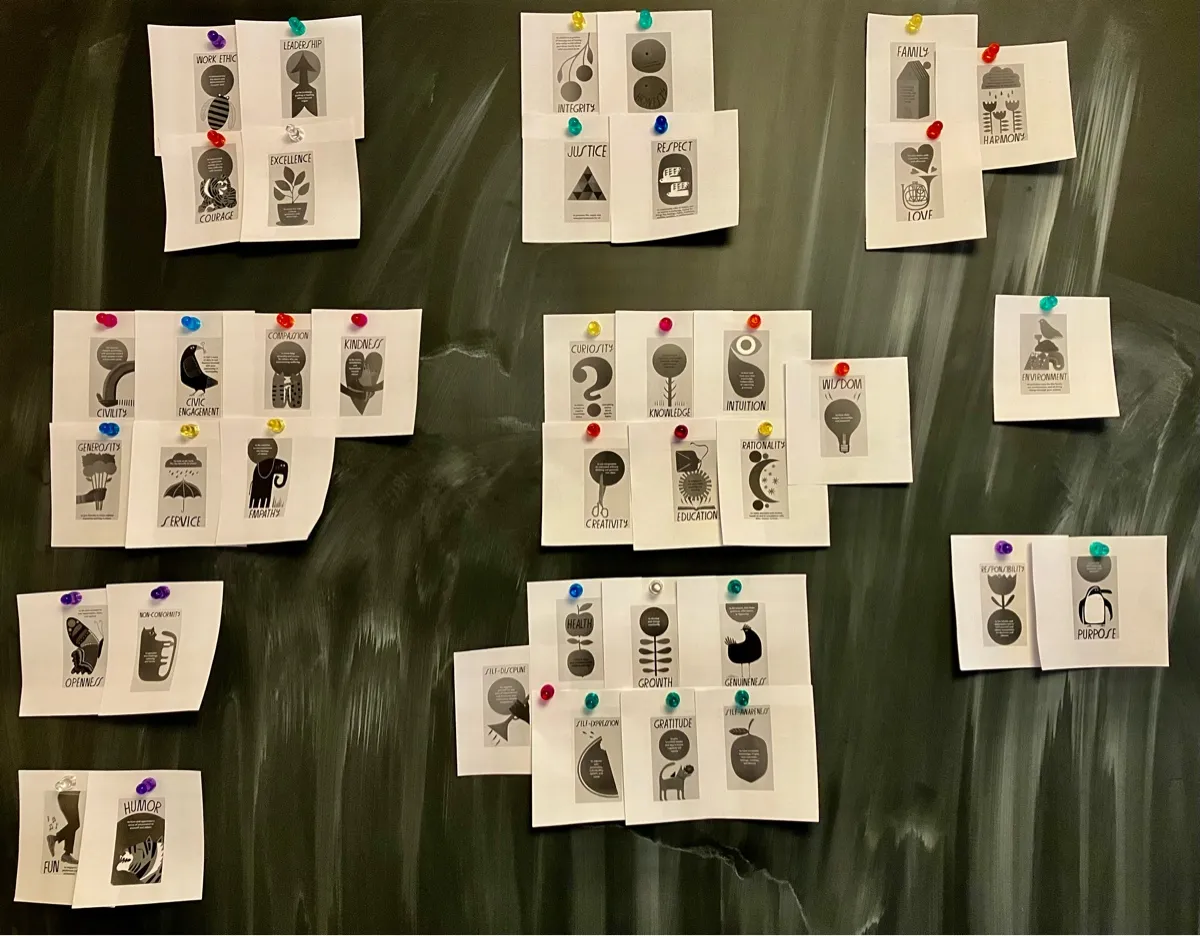
Photo of my blackboard where I grouped the remaining values
Next, I grouped all these values in a way that makes sense to me at this point. It is hard to explain exactly my reasoning. Here’s an example: wisdom, knowledge, intuition, creativity and a few others seem as part of a group for me. I generally think of all of these in any creative activity I do and so I put them all together. Some values could be part of multiple groups, but I decided to allow them to be part of only one group to not allow things to go completely out of control.
Identities
Think about your desired identity and ask, “Who is the type of person that could get the outcome I want?” - James Clear - 30 days for better habits #1
My next action will be to use these groups of values and define several identities for myself for different areas of my life: who am I as a parent, as a husband, as a professional, as a community member or as a friend. These identities will be described through an enumeration of values from these groups. Since there are quite a few values in these groups, I will select some of the most dominant ones for each identity and not necessarily from each group. This part of the process is still work-in-progress, once I get going with this stage, I will figure out what works best for me.
The values part of which identify will be expressed as a verb and adverb pair.
“As Jenna Lejeune puts it in her book, Values in Therapy, values are about “verbs and adverbs.” To get at a person’s values, you can ask:
• What would you be doing if you were living meaningfully? (verb)
• How do you want to show up to whatever you’re doing? (adverb)” (Casey Rosengren, How to Live by Your Values This Year)
Goals
With these identities in mind, I will try to define a number of goals. Since I don’t want this to be overwhelming, I will select 1 or 2 identities to begin with.
The focus should always be on becoming that type of person, not getting a particular outcome. In the beginning, it is far more important to cast small votes for your desired identity than to worry about a particular result. - James Clear - 30 days for better habits #1
“Another way we think about values in ACT is as meaningful life directions, whereas goals are milestones on the path.” (Casey Rosengren, How to Live by Your Values This Year)
Goals are stepping stones on the path of becoming more like the defined identities. The goals should be concrete and achievable. The identities are more of an ideal and they will change with time.
Habits
Once you have a handle on the type of person you want to be, you can begin taking small steps to reinforce your desired identity. - James Clear - 30 days for better habits #1
What are some small steps I can take in order to be more like the ideal me(s)? As James Clear advises in his course and book, I should start with really small actions (that take less than 2 minutes) to get me going.
Increase awareness
To be able to identify habits and track progress towards my goals, I need to be more aware of myself, which is where the other parts of ACT and the ideas in Aware come into play.
Concepts like avoidance, psychological flexibility, willingness, defusion and wheel of awareness help to identify areas of improvements and get ideas on what new steps to take towards the goals I set.
This is hard work and it is not the first time I set my mind on doing something like this. It is also an ongoing activity that will most likely never end. I will let you know how it is going! 🚀