DISCLAIMER: This post has nothing to do with my employer. We are doing many things right, but that doesn’t change my opinion it is harder to make a group of consultants behave like a team than let’s say a group of software engineers in a product company. Opinions are my own and not the views of my employer and so on and so forth.
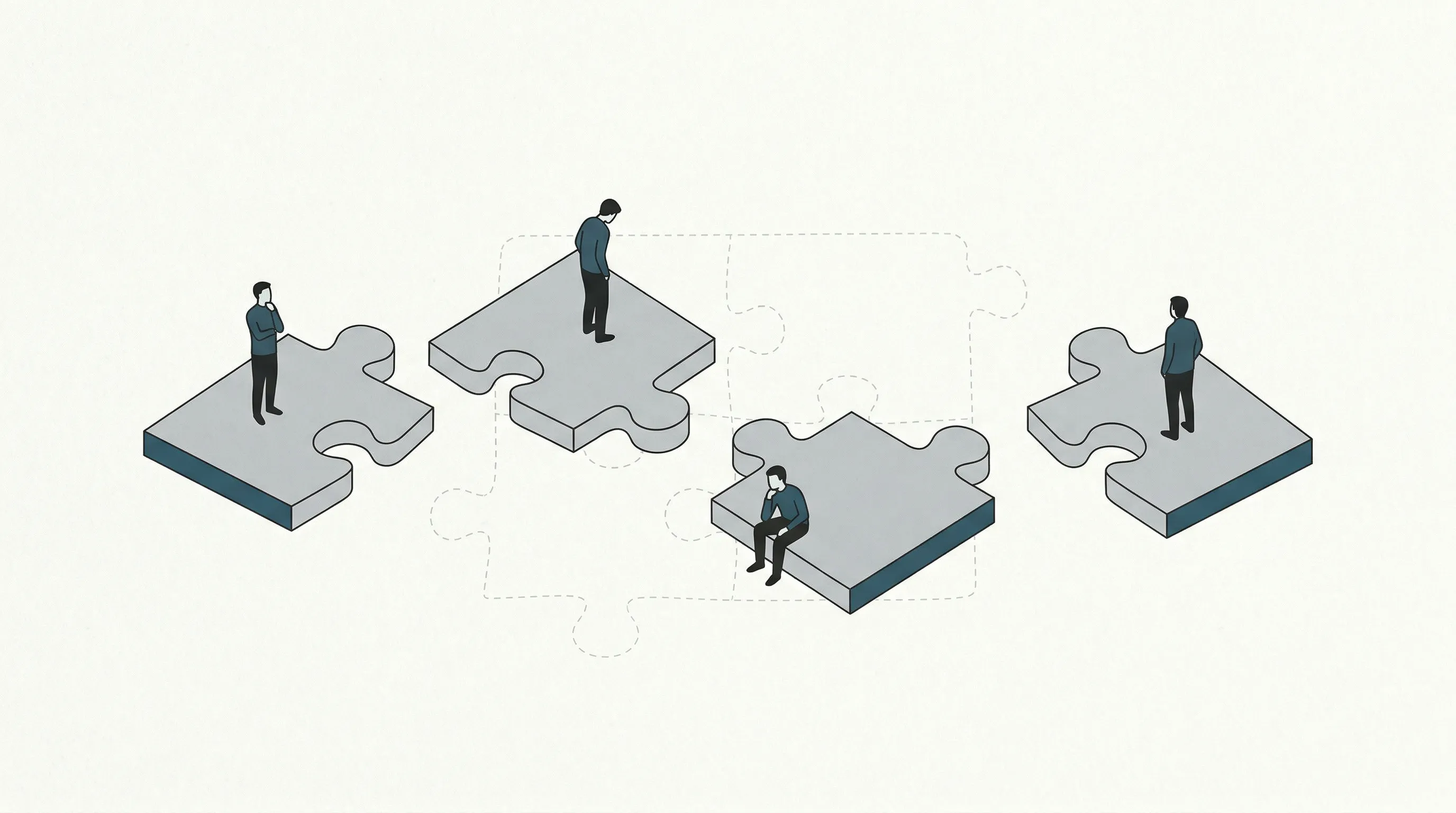
Consulting companies are also usually organized in teams. I argue here that it is harder for these groups of people to fit the bill for the definition of a team, through the nature of their work. I am not saying it is good or bad, just that it is different and I think it is worth pointing this out.
What is a team?
When it comes to defining what is a team, I found very useful and accurate the definition by Richard Hackman and Ruth Wageman in A Theory of Team Coaching. According to them, all teams have three defining features:
- “[Teams] are real groups. That is, they are intact social systems, complete with boundaries, interdependence among members, and differentiated member roles (Alderfer, 1977). Members of real groups can be distinguished reliably from nonmembers, they are interdependent for some common purpose, and they invariably develop specialized roles within the group. Real groups can be either small or large and either temporary or long-lived.”
- “Work teams have one or more group tasks to perform. They produce some outcome for which members bear collective responsibility and for which acceptability is potentially assessable.”
- “Work teams operate in a social system context. The team as a collective manages relationships with other individuals or groups in some larger social system.”
I find the second point the most challenging. Let’s start with that one.
They produce an outcome for which members bear collective responsibility
Consultants by definition consult. They are essentially working most of the time with one or more customers (or at least that is the ideal situation). Having the full team of consultants working at the same customer (even a sub-group of the team) is quite rare. This means that the members of a team of consultants work most of the time on tasks on which they do not bear a collective responsibility. In fact, in long term assignments, it is common for consultants to identify more with the team at the customer (where they do tasks on which the customer team has collective responsibility) than with the team at the consulting company. Maybe this is a reason why it is relatively common for consultants to switch jobs to work internally for companies they consulted for a longer time.
Some consulting companies reserve time for their consultants to spend time with their consultant team, to do all kind of activities together with a common goal. This helps enhance the unity of the group and get people to better know each other professionally, to solve problems together and to develop together. Unfortunately, these activities have many times an artificial nature and are sometimes harder to prioritize in the face of billable hours. I would say this is one of the biggest challenges of consultant teams. And the main effect is that the team unit is much easier to break and for people to leave.
Teams are real groups, intact social systems, complete with boundaries, interdependence among members, and differentiated member roles
In consulting companies, consultants are organized in teams based on specialties or area of expertise. I find this to cause in effect weaker boundaries between teams and not be unusual to have people who are effectively part of multiple teams. An aspect that it is again related to the previous point about collective responsibility on outcomes. In the absence of those, teams become more fluid, more of an organizational convenience than a way to enhance for flow.
Work teams operate in a social system context
That is something that I don’t see as different in consulting companies. Actually, consultants become quite good at operating in multiple social system contexts: at the customers and in their company. As with everything else, they get better at operating in these contexts the more time they spend actively in them.
Bonus: consulting managers
An extra aspect to mention is related to consulting managers. Consultants usually have managers they report to in their company. Since consulting managers generally do not work together at the customer with their direct reports, this makes it rather difficult for them to support and help their reports in their development. The information that a manager gets first hand in a product team, in a consulting team it comes less often and it is a second hand witness report most of the times. On top of that, some consulting managers are also involved in sales activities which makes this position again a bit different than that of a manager of a product team.
Conclusion
It might look like I wrote this post to criticize consulting companies or point out that groups in consulting companies are not actual teams. Not at all.
I am a consultant by choice and I enjoy being a consultant. One of the points of this post is to show some of the differences with teams in product companies.
My second point is that it requires more effort to make consultants behave like a team. Real teams don’t happen just because you put some people under the same organizational unit. And this is valid for any company, regardless of the type of work.