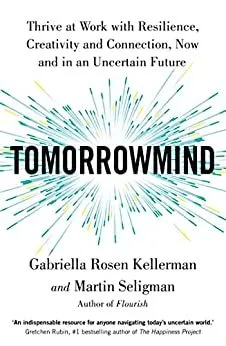
This is a book whose ideas revolve around what it takes to be thriving at work, in this ever-more-changing environment we find ourselves right now. Released at the beginning of this year, the book is able to take the COVID-19 pandemic into consideration and make its ideas even more relevant.
Its authors, Gabriella Rosen Kellerman and Martin Seligman, state that work thriving requires people to master 5 psychological powers:
- Prospection (P)
- Resilience and cognitive agility (R)
- Creativity and innovation (I)
- Rapid rapport to build social support (S)
- Meaning and mattering (M)
But this is not only up to each individual, organizations can also foster an environment where these 5 powers (PRISM) can be developed.
Here are several ideas from the book related to organizations and thriving:
- Employee thriving cannot be nourished by focusing on short-term gains. It is something that needs constant investment and its benefits cannot be collected immediately, but these gains in productivity can generate large returns-on-investment on a long-term.
- Invest in and encourage prospection. “Teams whose leaders score higher in prospection perform better in a number of critical dimensions: team engagement is 19% higher; team innovation scores are 18% higher; and team agility, as measured with a cognitive agility scale, is 25% higher.
- A study from 1997 “showed that people view their work as either a job, a career or a calling”. These are focused on financial rewards, on professional advancement and on fulfilling work respectively. Needless to say, you want to have as many employees that see their work as a calling. It is also the best perspective for their health, as it has a positive effect on their well-being.
- Another study from New Zealand, discovered that the seven most common drivers of workplace meaning are personal growth, professional growth, shared purpose, service, balance, inspiration and honesty.
- Creativity is linked to our ability of spending time on activities that are not mentally-demanding. This is the time when our default mode (neural) network (DMN) activates and enters a mode of wild exploration (a.k.a. mind-wandering). “A wide body of studies has also found that mind-wandering is most productive when the focused work comes first: start with the deliberate problem-solving, then follow it with downtime. In our focused time, our executive control network is consciously planting ideas for our DMN to harvest.”
- “Time is one of the most significant barriers to social connection today. We believe ourselves to be suffering from a “time famine”: always with too much to do, and never enough time to get it done.
- “Workers who feel a greater sense of social support at work scored 47% higher on workplace meaning scales than those who did not.
- “When we help others, we experience that as time added to our day, rather than lost. Helping ourselves, by comparison, does nothing.
Originally posted on LinkedIn.