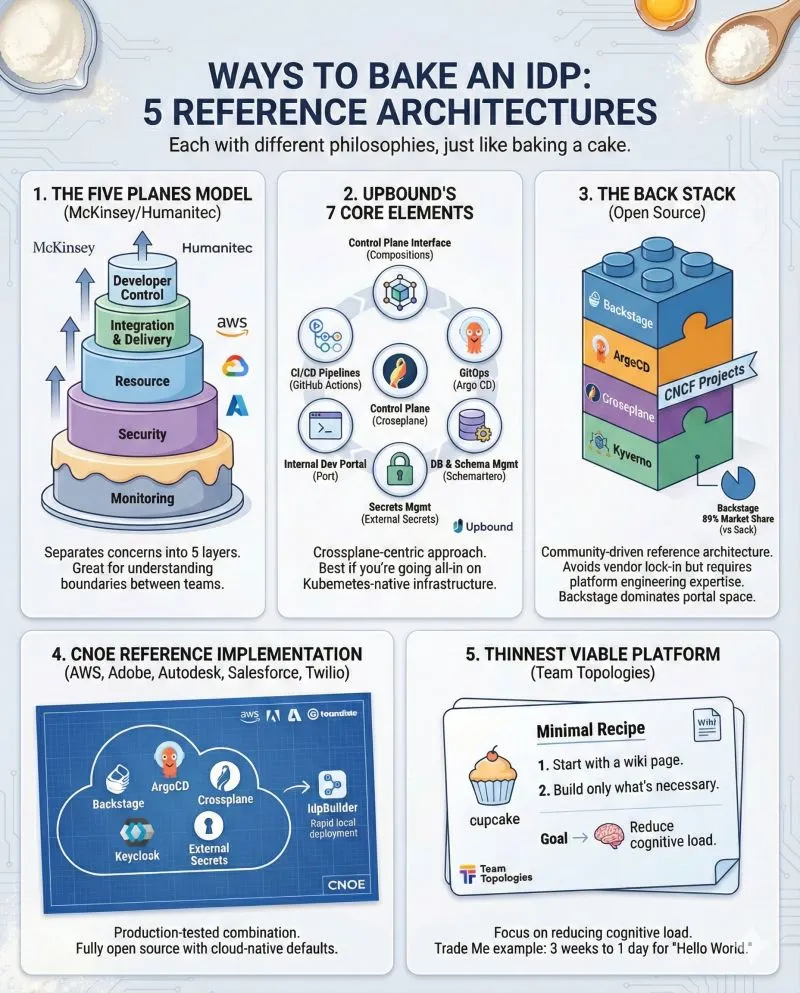
In the same way as there are many ways to bake a cake, there are many ways to implement an IDP. Nevertheless, there are several more popular IDP reference architectures or strategies, each with different philosophies:
-
The Five Planes Model (McKinsey/Humanitec) Separates concerns into 5 layers: Developer Control, Integration & Delivery, Resource, Security, and Monitoring. Presented at PlatformCon 2023 and implemented by Humanitec for AWS, GCP, and Azure. Great for understanding boundaries between teams.
-
Upbound’s 7 Core Elements Crossplane-centric approach with seven distinct components:
- Control Plane (Crossplane)
- Control Plane Interface (Crossplane Compositions)
- GitOps (Argo CD)
- Database & Schema Management (SchemaHero)
- Secrets Management (External Secrets Operator)
- Internal Developer Portal (Port)
- CI/CD Pipelines (GitHub Actions)
Best if you’re going all-in on Kubernetes-native infrastructure.
-
The BACK Stack (Open Source) Backstage + ArgoCD + Crossplane + Kyverno. A community-driven reference architecture using proven CNCF projects. Backstage dominates the portal space with 89% market share among organizations choosing between Backstage and SaaS alternatives (67% overall market penetration including homegrown solutions). Avoids vendor lock-in but requires platform engineering expertise.
-
CNOE Reference Implementation (AWS, Adobe, Autodesk, Salesforce, Twilio) Production-tested combination of Backstage, ArgoCD, Crossplane, Keycloak, and External Secrets. Fully open source with cloud-native defaults. Includes idpBuilder for rapid local deployment.
-
Thinnest Viable Platform (Team Topologies) Start with a wiki page if that’s all you need. Build only what’s necessary. Trade Me adopted this approach—focusing on reducing cognitive load, they went from 3 weeks to 1 day for first “Hello World.
Originally posted on LinkedIn.