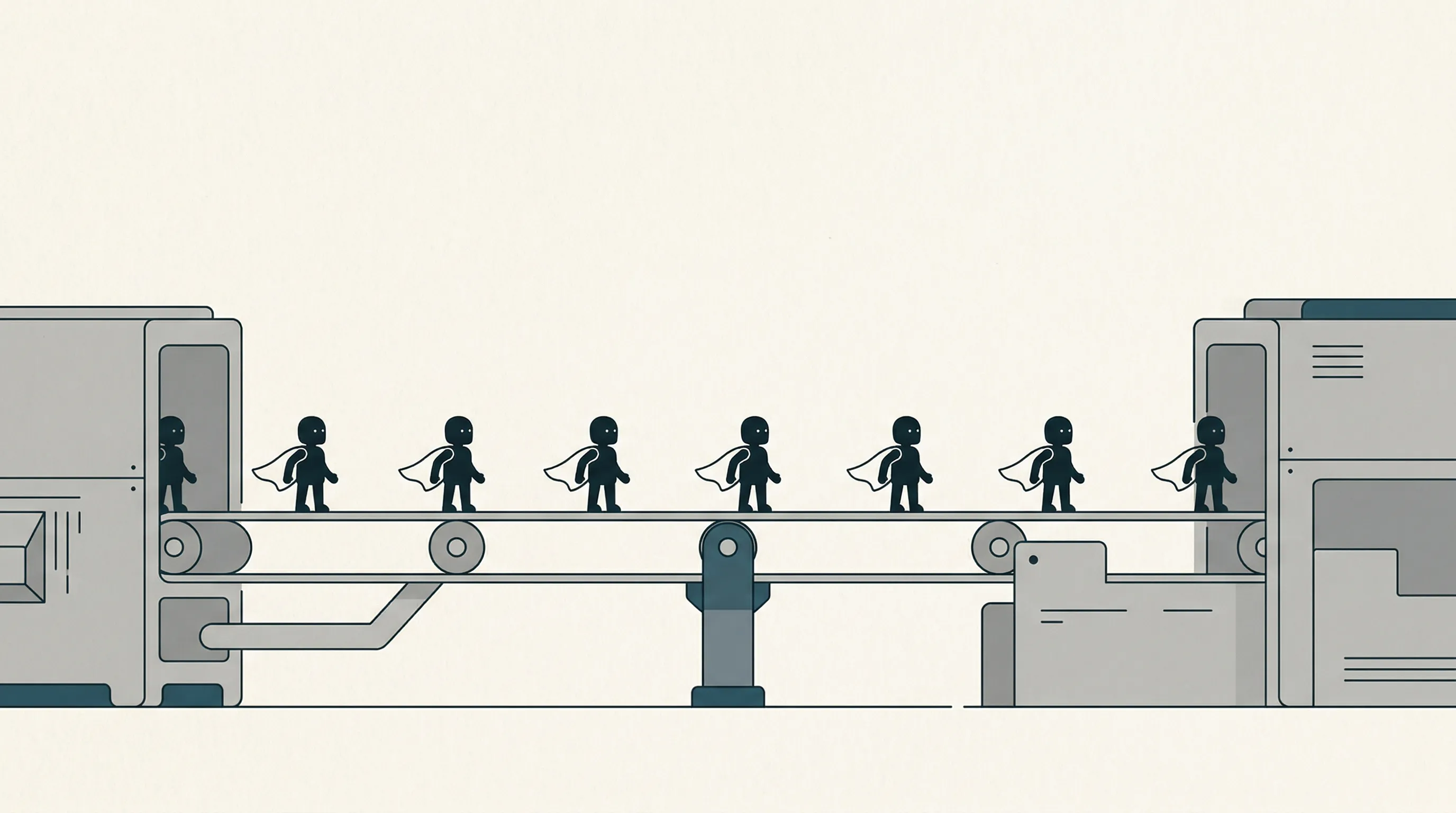
Working in teams is the de-facto standard for most companies doing some kind of knowledge-work. Every employee is part of a team of people, at least in the organizational diagram. But working in a team is a bit more than sharing a name with others in the organigram. It also means achieving the team purpose by working together as a team. This distinction is taken for granted by almost everyone, but if you look closely, the reality might be a bit different.
So everyone has teams, but not everyone in the team might be a team-player. This might be an individual choice or a systemic problem. I’m writing this to talk about the latter and how might an organization that I like to call “a hero factory” look and feel like.
One unwritten characteristic of working in teams is that ownership of work should not go lower than team level. Being generally unwritten, it is easy to overlook and in many cases it is ignored.
What this means is that team members should not generally be specialized on a specific type or area of work. This creates a hard dependency on one individual and it creates friction in the team and outside of it. If only one person can touch some specific work, it means they are bound to be a bottleneck. They can also frustrate the other team members because they might not contribute to the general cause of the team (or the other team members can also be relieved they don’t have to work with whatever the specialized team member works on). Only one person working with one specific work means also that if they are gone, for whatever reason, then there is nobody to pickup from where they left off (high bus factor). It is pretty common for teams to have such a team member, to a certain degree.
What about having a “team” of such people? I would say that is more a group of heroes than a team.
The hero typology is one of a very knowledgeable person in one or several areas that they get almost exclusively to handle. They are solution oriented and everyone says they get the job done, whatever the job might be in the area they activate in. They are usually the go-to person for any urgent or important task in their area. They also might not be that focused on leaving things behind in an orderly way, which many times has long lasting negative effects.
Some people fall naturally in the hero role, because they enjoy being in the spotlight and “just get things done”, but some are molded into playing that role by the work environment of a hero factory.
How are hero factories built?
Some common causes for a hero factory are having insufficient people for the work that needs to be done in the team and/or a micro-managing boss. Sometimes, both factors can be present at the same time, for maximum effect.
Team work requires some kind of synchronization between the team members. They need to be on the same page in order to work well together. They could do tasks together or have ways to transfer knowledge, but this takes time. If “there is no time”, then it’s easier “to just do it” and encourage people to work alone. Especially in an immature team, this is the obvious conclusion when faced with a lot of pressure to deliver.
The micro-managing boss only makes it more complete by assigning specific individuals to each task. After a while, specialization is inevitable and the work is complete, the hero factory is in full-swing. But the cycle repeats itself, because when someone leaves, someone else takes their place in the machine and will go through the same process. This will even happen faster than for the members when the team was new because all the mechanisms are already in place and the machine is hungry for deliverables.
If it’s not clear, building hero factories is something to avoid. They come with a high cost for the employees and the company. They seem to achieve a lot with little on a short term, but on a long term they are a disaster waiting to happen. The team is the smallest unit owning work in the company and it should not be broken apart.